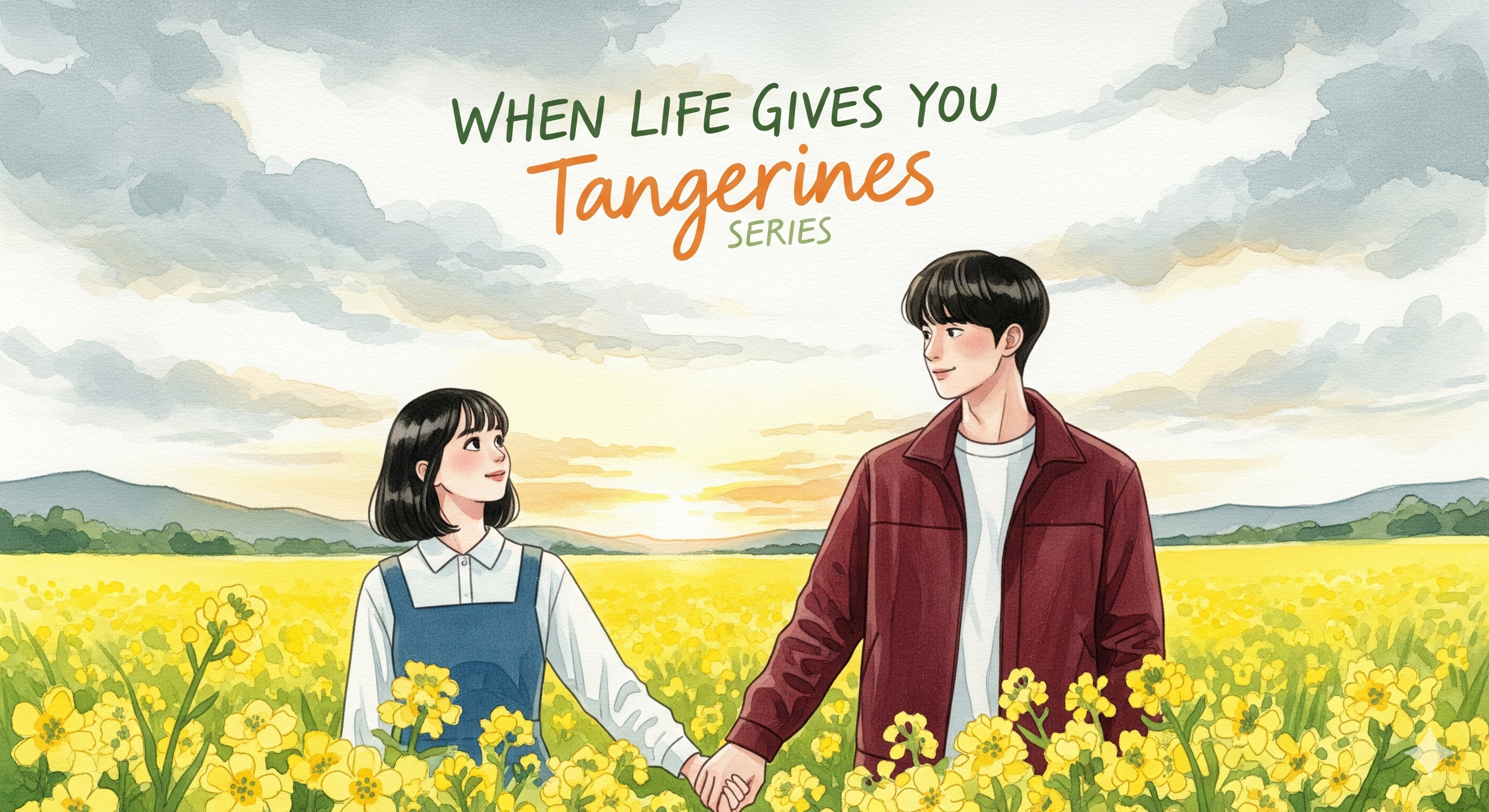
When Life Gives You Tangerines (2025) was the first K-drama I watched after many years. I had heard so many good things about it that when I finally got the chance, I thought—why not give it a try and see if it really lived up to all the praise?
The Concept
At its heart, When Life Gives You Tangerines is a decades-spanning romance. It follows Oh Ae-sun (IU), a dreamy and spirited young woman, and Yang Gwan-sik (Park Bo-gum), the sturdy, loyal boy-next-door type who has loved her from the very beginning.
Set primarily on Jeju Island during the 1950s and 1960s, the story unfolds across four “volumes,” each representing a different stage in their lives—from innocent youth, to turbulent adulthood, to the fragile but dignified years of old age.
What makes the drama unique is its quiet storytelling, which explores the resilience of ordinary people against the backdrop of history and change—war, poverty, modernization, and personal loss.
The Cast
- IU as Oh Ae-sun – Honestly, who better than IU to play Ae-sun? She embodies that perfect mix of headstrong independence and hidden vulnerability. Ae-sun feels like someone you might know, someone you might have grown up with.
- Park Bo-gum as Yang Gwan-sik – Park Bo-gum was born to play roles like this. After charming us in Reply 1988 (2015–2016) and Love in the Moonlight (2016), he returns with a character who doesn’t need grand speeches to prove his love. His Gwan-sik is steadfast, patient, and utterly devoted—exactly the kind of character who makes you sigh and mutter, “Where do men like this even exist?”
- Moon So-ri as Older Ae-sun – The transition from IU to Moon So-ri is seamless. She carries decades of love, regret, and resilience in her eyes. Every scene with her feels like watching time itself move.
- Park Hae-joon as Older Gwan-sik – If Park Bo-gum gave us the youthful glow of loyalty, Park Hae-joon gave us its weathered, wrinkled proof. He and Moon So-ri together were like poetry in motion.
The Plot
The drama is neatly divided into four phases of life—like opening an old diary and reading it cover to cover.
1. The Blossoms of Youth
We meet Ae-sun in her youth: fiery, idealistic, and a little reckless. She dreams of a bigger life beyond Jeju, sketching poetry in the margins of her schoolbooks. And then there’s Gwan-sik—the quiet boy who’s always there. He brings her snacks and quietly follows her around.
Their youth is a time of innocence but also of hardship. Post-war Korea is not forgiving, and their families face poverty and societal pressures. Ae-sun wants to break free, while Gwan-sik is content with what he has—as long as she’s in it.
The struggle of poverty is clear from the very first episodes. Little Ae-sun would anxiously wait at the rocky shore for her mother to return from diving deep into the ocean for abalones. Her mother, overworked and sick, provided for the family but had little energy left to show affection. With her biological father gone, Ae-sun was forced to live with her uncle and grandmother, enduring their taunts and mistreatment.
When Ae-sun’s mother passed away, I realized this show wasn’t going to be an easy ride filled with sunshine and rainbow. Despite the heartbreak, I was already invested—desperate to know more about Ae-sun’s life.
2. Marriage and Family
This volume shows Ae-sun and Gwan-sik in their teenage years. After her mother’s death, Ae-sun’s world fell apart. Her stepfather remarried and had children with his new wife, leaving Ae-sun to act as a free nanny for her step-siblings. Her uncle (her biological father’s younger brother) constantly taunted her to get a job instead of “freeloading.” Through it all, Gwan-sik loved her with every part of his being. He never saw Ae-sun’s tragedies as separate from his own.
Little Gwan-sik cried rivers when Ae-sun lost her mother. He always brought her fish, so she wouldn’t be deprived of good food by her uncle’s family. The two even tried to elope to escape their misery—only to lose their belongings and be rescued by Gwan-sik’s mother. From then on, his mother became determined to separate them.
Under pressure, Ae-sun even tried to convince herself to marry an older man, hoping at least she wouldn’t have to worry about food, shelter, or education. But ultimately, her heart led her back to Gwan-sik. One night together when Ae-sun and Gwan-sik had eloped, changed everything: Ae-sun became pregnant and they got married.
But fate was cruel. Even after the birth of their daughter Geum-yeong, Ae-sun was still not accepted by the family. Gwan-sik worked hard to feed them, while Ae-sun had to abandon her dream of going to college. When Gwan-sik discovered that Ae-sun was being abused by his mother and grandmother, he finally held her hand and walked out of the house.
And life only became harder. Ae-sun and Gwan-sik went on to have three children—Geum-yeong, Eun-myeong, and Dong-myeong. They struggled daily just to put food on the table. Then tragedy struck again: their youngest son was claimed by the sea. The cruel irony was unbearable—the very sea that sustained them also took away their child. The young parents were devastated beyond words.
3. Mid-Life and Children’s Struggles
The story leaps forward to their middle age, showing the challenges of raising their children.
Ae-sun and Gwan-sik had moved to the city, but keeping up with the world was still a losing battle. Sending their children to top universities and giving them a better life remained a distant dream.
A major plot point centers on Geum-yeong, their eldest daughter, who earns a scholarship to study abroad. But she faces discrimination and mistreatment from her rich boyfriend’s mother, who considers her working-class family a disgrace. Geum-yeong breaks off the engagement to protect her parents from humiliation. Her decision mirrors the hardships Ae-sun herself once faced.
Later, Geum-yeong finds true love while working at a cinema hall, with a man who is as protective and affectionate as her father. Eun-myeong, meanwhile, falls in love with the playful daughter of Ae-sun’s ex—the same older man she had rejected in her teens. The children, however, struggle to understand the depth of their parents’ sacrifices or the wounds of poverty that still haunt them.
4. The Winter Arrives
The series concludes with the characters in their old age. Gwan-sik is diagnosed with cancer, which he has quietly lived with for some time. After years of bone-breaking work, he is now weak and frail. Even his otherwise bratty son, Eun-myeong, begins to take responsibility—finding a job to support his wife and children.
Gwan-sik, even in his final days, worries about Ae-sun and how she will survive without him. Eventually, he passes away peacefully, leaving her alone.
But the ending is not entirely tragic. Ae-sun continues to live fully even after his death. She finally fulfills her dream of becoming a published poet. She also volunteers at a nursing home, teaching poetry to the elderly—a testament to her lifelong love of learning and words.
My Fangirl Commentary
It’s been more than 3–4 months since I finished When Life Gives You Tangerines, yet the emotions are still alive in my chest as if I just watched it yesterday. This drama wasn’t just another series—it felt too real, too close to life, more than any movie or show I’ve ever experienced. There are countless scenes that tugged at my heartstrings, but here are some of the ones that live rent-free in my mind:
1. Ae-sun’s mother’s last night.
Before passing away, she spends the night pouring her wisdom into her daughter—teaching her how to survive in a cruel world. She even visits Ae-sun’s grandmother (her mother-in-law) one last time, entrusting her child’s care. Later, the grandmother secretly hands over her savings at a crucial moment, which helps Gwan-sik buy a boat and keep the family from starving. That quiet act of love shaped Ae-sun’s fate.
2. Gwan-sik, the forever-devoted lover.
From the very beginning, Gwan-sik was the embodiment of quiet devotion. He was always looking out for Ae-sun—not with empty words or false promises, but with the kind of love that bets an entire lifetime on protecting her.
At first, I’ll admit, I found Ae-sun’s behavior towards him a little frustrating—sometimes cold-hearted, sometimes distant. But slowly, layer by layer, her love revealed itself. She was the girl who would scream and chase off the kids that bullied him, the one who would shyly slip her hand into his pocket instead of holding his hand outright, the one who constantly questioned whether Gwan-sik’s kindness came from pity or from love.
And then there’s Park Bo-gum as Gwan-sik—oh my heart. He made me want to believe in true love all over again. There were no grand gestures, no dramatic rescues, no fireworks-in-the-sky kind of moments. Just gentle love, quiet sincerity, and a whole lot of hard work. Honestly, where on earth do you find a man like this? I even managed to overlook Bo-gum’s ridiculously handsome face because I was too busy falling in love with Gwan-sik’s tender and genuine heart first!
What struck me most was his growth. Gwan-sik began as a timid boy, barely able to stand up to anyone. But when it came to protecting Ae-sun and their marriage, he became unshakable—the shield between her and the harshness of his mother and grandmother. That’s love in its truest, rawest form.
3. IU double-casting brilliance.
I felt so silly when I realized IU also played Geum-yeong, Ae-sun’s daughter. For a while, I honestly didn’t notice—they looked and felt like two entirely different people! And then… boom. Mind blown.
4. Geum-yeong’s heartbreak.
Her first love story mirrored her mother’s struggles. The lunch scene where her boyfriend’s wealthy mother humiliates her—ouch. Ae-sun, with quiet dignity, steps up to serve food, defending her daughter’s worth. That clash of class and pride felt painfully relatable, even across cultures. But what I adored was how both of Geum-yeong’s love interests reflected her father—gentle, protective, loving. The first faltered under pressure, but the second (and his sweet mother!) embraced her wholly. Can I just say—“Where do I apply for a mother-in-law like that?”
5. Dong-myeong’s death.
Dong-myeong’s death made my heart sink… Honestly, I’m not the kind of person who cries easily in real life or gets overly emotional with fictional stories. But this plotline shattered me. The loss of a child is something nothing in the world can ever fill. The two older siblings, still children themselves, carried guilt they should never have known. Ae-sun became a living corpse, and while Gwan-sik sobbed silently inside, he forced himself to stay strong in front of the family.
What broke me even more was how Eun-myeong’s birthday fell just three days after his younger brother’s death—so his birthday was never celebrated at home again. Gwan-sik, with his quiet love, made sure to secretly take him out for a nice lunch so the boy wouldn’t feel erased by the shadow of someone who was no longer there.
The village, though equally poor and struggling, came together to feed the kids while Ae-sun mourned for days on end. That solidarity was both heartbreaking and beautiful.
Even in the later episodes, the wound never closed. Ae-sun never stopped visiting the grave with food and toys, and Gwan-sik would secretly follow her—crying his heart out from a distance. In their youth, they never really spoke about the loss, each carrying their pain alone. It wasn’t until the winter of their lives that Gwan-sik finally confessed he had been haunted by their child’s death for decades, but could never share it, knowing Ae-sun was already suffering too much.
6. Eun-myeong’s arc.
Forever overshadowed by his sister, he became rebellious, bratty even. But beneath it all, he was soft-hearted, desperate to make his parents proud. His flaws made him feel so painfully real.
7. The “villain” Bu Sang-gil.
Now here’s a character who made me roll my eyes and sigh in equal measure. Bu Sang-gil was already married when he set his sights on Ae-sun, promising her a chance at college if she married him. But behind that shiny offer, he was hot-tempered, ill-mannered, and, honestly, the kind of man you just know would ruin someone’s peace of mind.
After Ae-sun married Gwan-sik, Sang-gil employed him on his boat—only to grow bitterly jealous watching the young couple’s love bloom right in front of him. Eventually, Gwan-sik was lucky enough to buy his own boat and broke free from Sang-gil’s shadow, which only deepened the man’s resentment.
And then, fate stirred the pot—their children fell into a love affair. Even as an older man, Sang-gil couldn’t let go of his jealousy toward Ae-sun and Gwan-sik. He envied the tender bond between Gwan-sik and his daughter, who was the spitting image of her mother. The father-daughter duo would watch sunrises together from a boat, a ritual that cut Sang-gil deeply when he tried to connect with his own daughter and was instantly rejected. After all, he had never cared enough to nurture his relationship with his wife or children.
Yet beneath all that bitterness, there were glimpses of something softer. Sang-gil was still a father who cared in his own stubborn, prideful way—too proud to dote on his grandchildren openly, but quietly helping his son-in-law Eun-myeong during a crisis.
In the end, Sang-gil wasn’t really a villain. He was more of a deeply flawed man—petty, jealous, prideful—but human all the same.
8. Gwan-sik’s death.
I was braced for this one, but it still destroyed me. Park Hae-joon portrayed the older Gwan-sik with such warmth and fragility—yelling at his bratty son one moment, tenderly fussing over Ae-sun the next. And the little things he left behind? Moving things to lower shelves for her, fixing windows, stocking up on her beloved hair clips—this is love in its purest form.
I have just one heart, Gwan-sik… how many times will you steal it?
9. The full-circle moment.
After Gwan-sik’s passing, Ae-sun lives on and finally becomes a published poet. Her book ends up in the hands of her mother’s reincarnation—who can’t stop crying while reading her daughter’s life story, as if some part of her past love and regret remained. That scene wrecked me. It was haunting and beautiful all at once.
10. Watching in Hindi (and then in Korean).
At first, I tried watching it dubbed in Hindi since I was returning to K-dramas after a long gap. But later, I rewatched key scenes in Korean and wow—the impact was so much stronger. Since then, I’ve stuck to original audio for all my K-dramas. Lesson learned!
11. The Title Track “Spring.”
I still hum it, months later. The melody is etched into my soul. It perfectly captured the show’s bittersweet beauty.
12. My newfound obsession.
This show introduced me to IU and Park Bo-gum, and now I’ve basically gone on a binge of their entire filmographies. IU’s music, Bo-gum’s earlier dramas (Hello Monster (2015), Reply 1988 (2015-2016), Love in the Moonlight (2016), Encounter(2018), Record of Youth (2020), Good Boy (2025) )—I devoured them all. And don’t even get me started on Kim Seon-ho (Geum-yeong’s husband). After seeing him here, I immediately jumped to Hometown Cha-Cha-Cha. Let’s just say Tangerines was the gateway drug that reignited my K-drama craze—I’ve since clocked 10+ shows back-to-back. No regrets.
Final Verdict
All in all, I’d rate When Life Gives You Tangerines a rare 9.5 out of 10 tangerines. It made me laugh, it made me cry, and it reminded me to hope again—for love that is steady, gentle, and enduring. The emotions were raw, the storytelling achingly human.
In final note I’d like to say, when life gives you tangerines, I hope it also gives you evergreen love like Ae-sun and Gwan-sik, that gives you comfort and hope. 🍊

Love In the Moonlight (2016) – A Swoon-worthy Love story
A girl forced to live as a boy, a prince who sees beyond disguise, and a twist of fate that lands her in the heart of the royal palace… Love in the Moonlight begins with a secret and unfolds like a soft, moonlit fairytale—with danger, destiny, and quiet beginnings of love.
That’s all for today. Thanks for stopping by!
Share this:

Discover more from Joy of Untangling
Subscribe to get the latest posts sent to your email.


