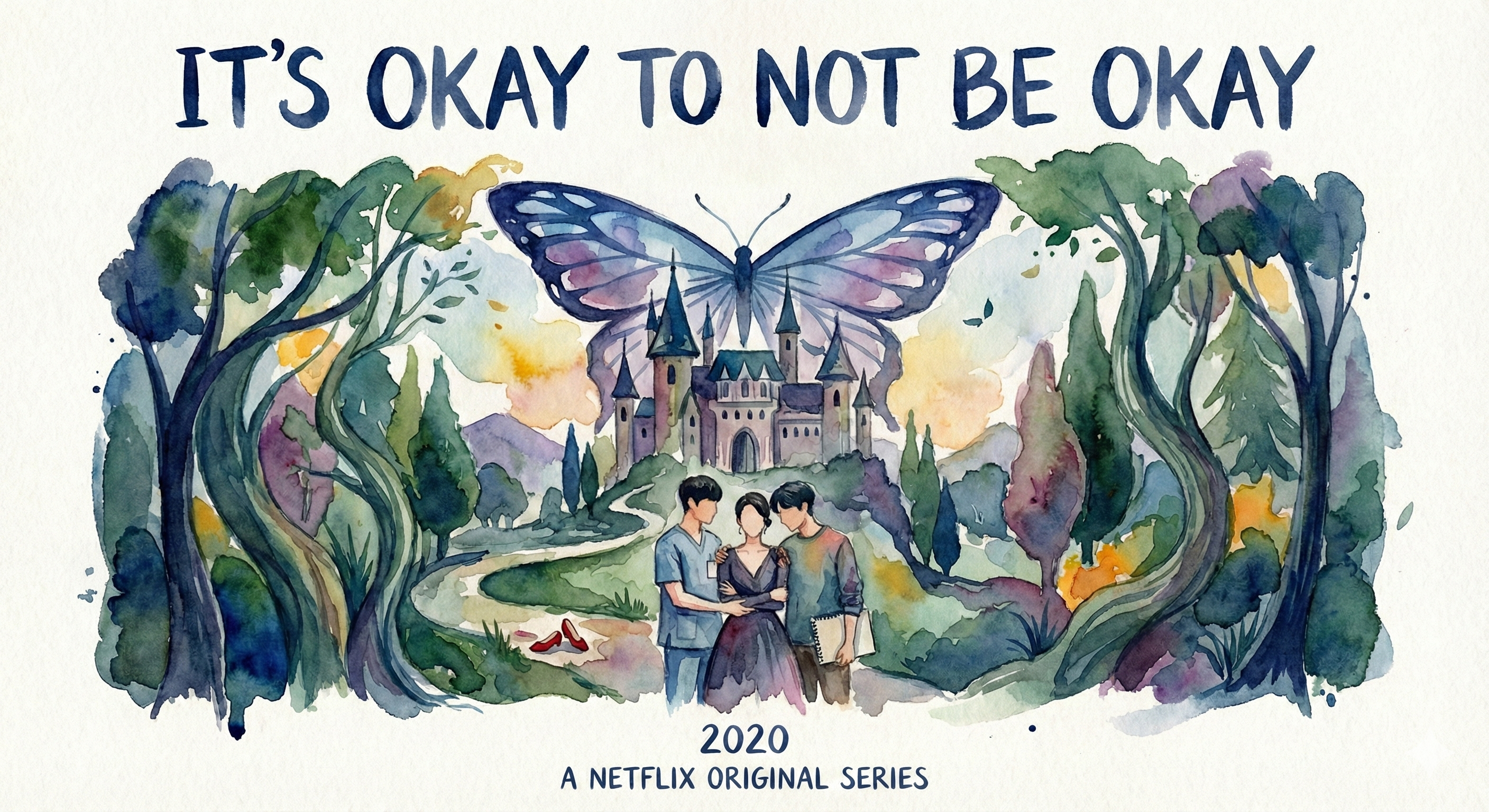
I was looking for some light-hearted K-drama to binge over the weekend, and while going down a rabbit hole of recommended shows, I discovered this one called “It’s Okay to Not Be Okay” (2020). It had pretty good ratings, and without peeping into the review comments (a very brave and slightly reckless move), I decided to give it a go.
Safe to say… I did not sign up for what I ended up feeling.
The Cast
1. Ko Moon-young played by Seo Ye-ji
Moon-young is not designed to be liked. She’s sharp, emotionally volatile, unapologetically selfish — and mesmerizing. Seo Ye-ji played her with such dangerous elegance that you never knew whether to root for her, fear her, or hug her (carefully). She wasn’t softened for audience comfort, and that’s exactly what made her compelling.
This was my first time seeing her… and not gonna lie, her tiny waist and extremely slim body got me for real. I genuinely don’t understand how these actors manage to have such healthy faces (no sunken eyes, no bones popping out, no malnutrition look) with bodies this slim. Genetics? Witchcraft? Korean skincare? Someone please explain.
2. Moon Gang-tae played by Kim Soo-hyun
Gang-tae is the emotional anchor of the show. Quiet, restrained, exhausted. Kim Soo-hyun portrayed suppressed trauma so convincingly that every tiny crack in his composure felt devastating. His performance was subtle, internal, and painfully human.
This is my third show of Soo-hyun. I’ve seen him in Queen of Tears (2024) as the male lead and in a 30-second cameo in Crash Landing on You (2019). While watching him in Queen of Tears, I remember telling myself, “Hmm… this guy is good… but not really my type.” And honestly, my main reason for watching that show was Kim Ji-won more than anything.
Somehow, I didn’t even realize that Soo-hyun was the male lead of this show until I started watching it. And guess what… My type totally changed.
3. Moon Sang-tae played by Oh Jung-se
Let me say this plainly: Sang-tae is the soul of this drama.
Oh Jung-se’s portrayal of a man on the autism spectrum was respectful, layered, and deeply moving. He wasn’t written as an accessory or an inspiration prop — he was central, complex, and essential. His growth arc? Quietly revolutionary.
Watching Oh Jung-se play the naive autistic elder brother was honestly trippy for me. I first saw him in When Life Gives You Tangerines (2025) in a small role as Ae-sun’s stepfather. He only really caught my attention later in Good Boy (2025), where he played a full-blown psychopath antagonist. Seeing him switch between these extremes so convincingly… respect.
The Plot of It’s Okay to Not Be Okay:
The story begins with Ko Moon-young, a cold-hearted children’s book writer. Despite earning a fortune writing for children, Moon-young seems completely estranged from them — and from the rest of the world. She’s arrogant, emotionally detached, and almost cruel, constantly making her poor publisher Sang-in clean up her mess.
We then meet Moon Gang-tae, a caregiver at a psychiatric hospital. His daily life consists of getting yelled at, slapped, puked on by patients… and then returning home to take care of his only family — his autistic elder brother, Sang-tae. Jae-su, Gang-tae’s friend from a side gig long ago, is now the closest thing they have to extended family.
Moon-young comes to Gang-tae’s hospital for a reading of her new book… and gets attacked by one of the patients. Gang-tae saves her, gets injured in the process while stopping her from retaliating, and just like that — fate starts doing its thing.
Now… let me rewind and give you the backstory.
Moon-young is the only daughter of a reputed professor and writer. Her father built a palace-like house deep inside a jungle. Her mother, a celebrated writer herself, was extremely controlling — watching Moon-young’s every move, moulding her into her own reflection.
Gang-tae and Sang-tae grew up in a struggling household with only their mother. Sang-tae’s condition consumed all of her time and energy. Little Gang-tae grew up feeling invisible, always asked to take care of his brother, never having his own needs acknowledged.
One winter day, while playing near a frozen river, Sang-tae fell into the water. Gang-tae hesitated for a few terrifying seconds… then jumped in to save him. Sang-tae walked out of the water without looking back, while Gang-tae kept struggling inside.
Little Moon-young watched everything from a distance. And after seeing Gang-tae fight for his life, she rescued him.
From that day on, Gang-tae quietly followed Moon-young everywhere. But she remained distant and cold. One day, he gathered courage to give her flowers… only to find her tearing butterflies apart without remorse. That was the last time he ever approached her — but her memory stayed with him forever.
Then tragedy struck.
Gang-tae and Sang-tae’s mother was murdered one night. Sang-tae was the only witness. The trauma left him with a deep phobia of butterflies. The town wanted to separate the brothers — send Sang-tae to a hospital, Gang-tae to school — but terrified of losing his only family, Gang-tae ran away with his brother.
From then on, every spring brought nightmares. Every spring meant another breakdown. And every spring meant another move.
Back to the present.
After a hospital cover-up, Gang-tae is forced to take the blame and gets fired. His old friend Nam Ju-ri (who secretly loves him a lot) suggests he move to Seongjin, where she has a spare room and the psychiatric hospital needs caregivers.
Seongjin… their long-lost hometown.
After years of running, Gang-tae finally returns there with Sang-tae and Jae-su.
And of course — Moon-young follows.
For her, Gang-tae becomes a new obsession. Someone she wants to win. She moves back to her childhood home — now known as the “cursed palace.”
Moon-young’s father is the oldest patient at OK Psychiatric Hospital. She never visits him. Her mother is long dead. She has no one to call family.
Sang-tae, meanwhile, is obsessed with dinosaurs, drawing, and Moon-young’s books. Moon-young strikes an impulsive deal with him — he will illustrate her book and live in her house while doing so. Unable to stop his brother, Gang-tae reluctantly moves in too.
And slowly… a strange family begins to form.


Moon-young becomes a genuine companion to Sang-tae — sometimes bossy, sometimes sibling-like, sometimes like two chaotic roommates from a psychiatric ward.
Gang-tae, meanwhile, continues suppressing everything. At work he’s abused. At home he’s responsible. Inside, he’s still that little boy wondering why his mother never loved him.
The tension between Moon-young and Gang-tae is undeniable… but he’s been suppressing himself for so long that no one — not even him — knows what he really feels.
Things unravel. Secrets surface.
And the biggest truth hits like a truck — Moon-young’s mother was the one who murdered Gang-tae and Sang-tae’s mother.
The rest… is pain, confrontation, forgiveness, and healing.
In the end, Moon-young publishes a book illustrated by Sang-tae — about the three of them, as a family. The brothers finally get a camping car. Gang-tae quits his job. Moon-young takes a break from writing.
And the three of them leave on a road trip… without a destination.
My Fangirl Commentary & Final Notes:
1. Moon-young, my confusing queen
I was constantly on the fence about her. Was she born a psychopath and later moulded into a kind person? Or was she a normal child emotionally destroyed by a confirmed psychopath mother? The show never really gives a clear answer.
Also — every single outfit she wore deserved a red-carpet moment. And her voice… surprisingly deep. Completely caught me off-guard.
She’s also refreshingly bold. No shy glances, no hesitation — she jumps on Gang-tae, flirts openly, and enjoys throwing him off balance.
Icon behaviour.
2. The storytelling
Every episode being based on a fairytale? Genius.
Moon-young’s stories were beautiful… but honestly, way too profound for children. Maybe they weren’t meant for kids at all. Maybe they were for adults whose inner child still needed healing.
3. Gang-tae and my broken heart
Gang-tae reminded me so much of Baek Hyun-woo from Queen of Tears — another saintly man paired with a borderline crazy woman. Does Kim Soo-hyun have a type?
His emotional scenes destroyed me. Growing up craving affection… questioning his existence… wondering if his only purpose was to take care of his brother…
Watching him finally learn to live freely, express love, fight back, choose himself — that was healing in itself.
4. Sang-tae, the real MVP
He never becomes the third wheel. Instead, he becomes the glue.
He becomes the elder brother Moon-young never had. The emotional bridge between the lovers. And slowly, we see his own wounds — his guilt, his memories, his love for both his mother and his brother.
His journey was just as heart-warming as the leads’.
5. The side characters
Every side character had their own healing arc. Nam Ju-ri finding love. Sang-in being the quiet guardian angel. Ju-ri’s mother becoming “home” to every broken soul.
Even the patients… each carried stories heavier than they looked.
Final Verdict
I’d rate “It’s Okay to Not Be Okay” (2020) a solid 8.5/10.
It’s a fairytale where the knight doesn’t save the princess.
Instead — the prince, the princess, and the elder brother save each other.
With love.
With warmth.
And with just a sprinkle of crazy.
Recommended Read

Queen of Tears(2024): Falling Back in Love Again.
Queen of Tears (2024) turned out to be one of those shows I started just for Kim Ji-won but ended up staying for everything else — the emotions, the chaos, the heartbreak, all of it. It’s dramatic, beautiful, and occasionally frustrating, but in the most K-drama way possible.
Other Blogs
When Life Gives You Tangerines (2025): A Love That Spans a Lifetime #435
When Life Gives You Tangerines (2025) is not just a drama—it’s a tender love letter to youth, family, and the kind of love that quietly endures through decades. Sweet, aching, and beautifully human, it lingers like the taste of a tangerine long after the last scene.
Share this:

Discover more from Joy of Untangling
Subscribe to get the latest posts sent to your email.


