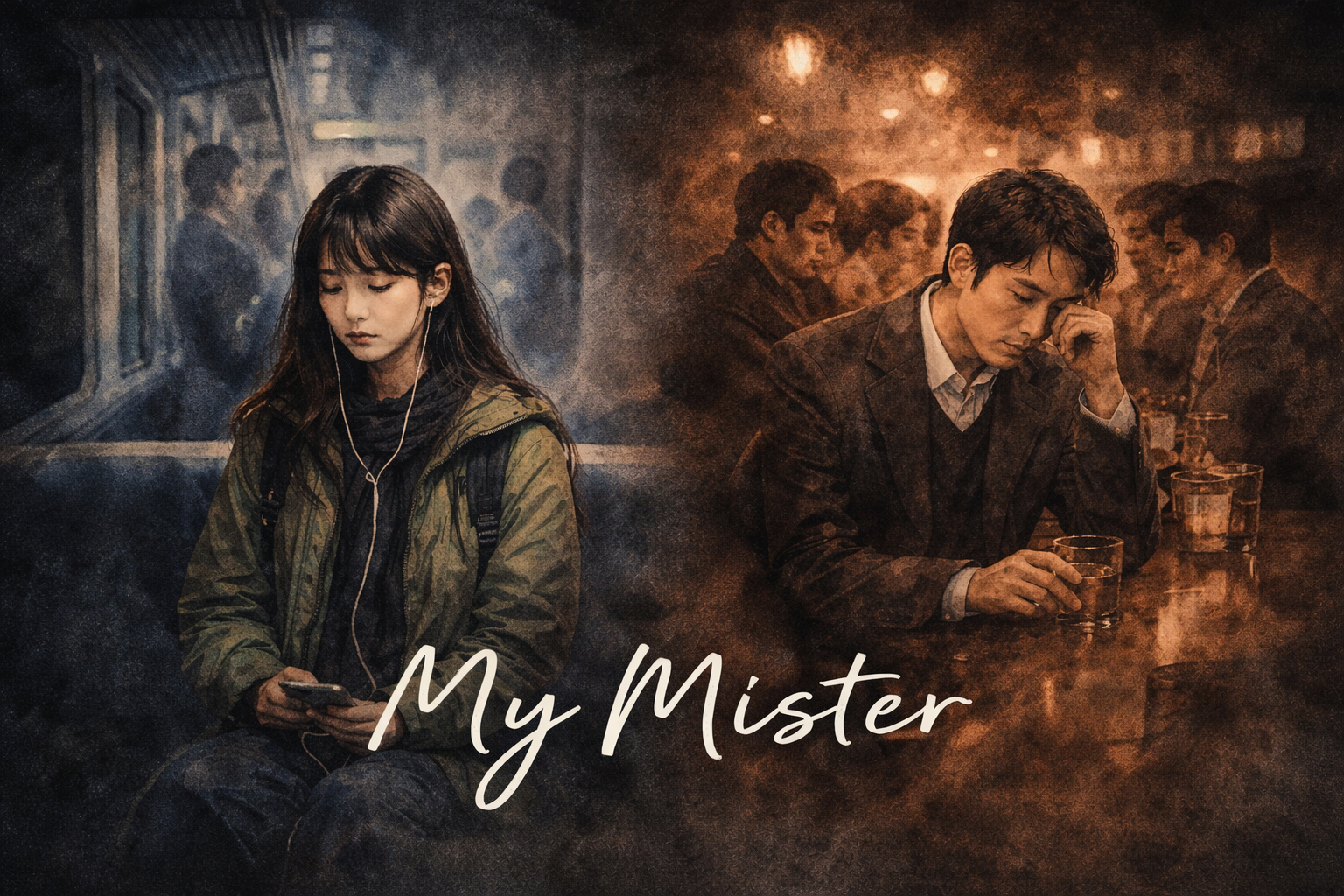
It’s been a couple of days since I finished watching “My Mister” (2018)… and my emotions are still scattered, like papers thrown into the wind. I keep replaying certain scenes in my head at the most random hours of the day. I’m hoping that by writing this, I can gently untangle what this show did to me, because it did something. Something quiet. Something heavy. Something that lingers.
My Mister used to pop up in my recommendations from time to time, almost like a patient friend waiting to be noticed. But there was always something else to watch—something lighter, louder, more obviously entertaining. Last week, when I finally decided to give it a shot, I went in with very little information. I only knew two things: it wasn’t a traditional romance… and it had pretty good ratings.
That’s it. And somehow, that was enough.
The Cast & Their Other Work:
1. Lee Sun-kyun as Park Dong-hoon
Lee Sun-kyun plays Dong-hoon with such restrained dignity that it physically hurts to watch. He is a middle-aged engineer; emotionally exhausted, morally upright to a fault. The kind of man who absorbs every disappointment quietly, like it’s part of his job description. He carries life’s burdens the way one carries a well-worn coat—heavy, familiar, and never really taken off.
There’s something deeply moving about how he underplays everything. No dramatic outbursts. No heroic speeches. Just silence… and tired eyes.
I had previously watched Lee Sun-kyun in “Coffee Prince” (2007), where he played the charming second lead. He was warm and sweet there, almost effortless in his appeal. And of course, he is globally recognized for his role in “Parasite” (2019), a film I still need to properly sit down and watch. Seeing him in My Mister feels like witnessing an entirely different shade of him. Quieter. Deeper. Devastating.
2. IU as Lee Ji-an
IU’s Ji-an is… devastating. There’s no other word for it.
She plays a young woman crushed by poverty, debt, and relentless loneliness. And yet, Ji-an is sharp, almost frighteningly sharp, when survival demands it. There’s a hardness to her, a defensive armor she has built brick by brick. But beneath that? There’s a child who has never known safety.
If you’ve seen IU in “Hotel Del Luna” or “Moon Lovers: Scarlet Heart Ryeo”, you already know she has range. But My Mister strips everything bare. No glamour. No fantasy. No dramatic styling to cushion her performance. Just raw, aching humanity.
I actually watched IU for the first time in “When Life Gives You Tangerines” (2025) and completely applauded her acting there. She sings, she dances, she acts—she’s the whole package. But in My Mister, she does something even more powerful. She sits in silence. She lets the pain breathe. And somehow, you feel every ounce of it.
Supporting cast that matters
And I really mean matters.
i. Park Ho-san as Sang-hoon – the loud, broken brother with the softest heart.
ii. Song Sae-byeok as Gi-hoon – the struggling director still clinging to dreams that the world seems to have forgotten.
iii. Lee Ji-ah as Yoon-hee – Dong-hoon’s wife, caught between guilt and yearning. (For the first few scenes, I genuinely mistook her for Yoo In-na… after watching so many K-dramas, I still get confused sometimes!)
What makes this ensemble so special is that they don’t feel like a “supporting cast.” They feel like neighbors you’ve known your whole life. The kind of people whose arguments you overhear through thin apartment walls. The kind whose struggles feel uncomfortably familiar.
No one exists just to move the plot forward. Every character carries their own loneliness. Their own quiet battles. Their own unfinished dreams.
And maybe that’s why My Mister doesn’t feel like a show you simply watch. It feels like a world you sit inside… and slowly, painfully, recognize.
The Detailed Plot:
Dong-hoon’s background:
Park Dong-hoon (~41 years old) is a general manager and structural engineer at Saman E&C, an engineering and construction firm where steel and concrete matter more than people’s feelings. Saman’s CEO, Do Joon-young, is his college junior… someone Dong-hoon deeply despises. Their history lingers beneath every professional interaction, unspoken but heavy.
The company itself is a battlefield of quiet ambition. Senior managing directors and the young CEO are constantly engaged in subtle power plays, each calculating their next move for personal gain. Promotions are not earned through merit alone; they are negotiated, manipulated, sometimes quietly stolen.

And then there is Dong-hoon.
He refuses to participate in the politics. He prioritizes being an engineer over being a political strategist. He believes in doing his job well. In integrity. In showing up. In not stepping on others to climb higher. And in a world driven by ego and advancement, that kind of decency almost feels… outdated.
At home, Dong-hoon is the second oldest, and the most “successful” son.
The eldest brother, Sang-hoon (~49), was laid off years ago from a large company. A failed business venture with his wife left him drowning in debt. Now he spends his days drinking, drifting, and living in their mother’s apartment, carrying shame like an invisible scar.
The youngest brother, Gi-hoon (~mid-30s), once dreamed of becoming a successful film director. That dream didn’t quite materialize. He remains unemployed, clinging to fragments of artistic hope while reality quietly presses down on him.
For both brothers, Dong-hoon’s corporate job at a prestigious firm feels like the “only good thing” left in their lives. He isn’t just their brother, he’s their stability. Their proof that at least one of them “made it.”
And then there’s Yoon-hee—Dong-hoon’s wife. An attorney at a major law firm. Intelligent. Polished. Likely earning significantly more than him. On paper, they look like a power couple. But emotionally? There are cracks in that picture. Subtle at first… then impossible to ignore.
Ji-an’s background:
Lee Ji-an (~21 years old) is a temporary employee at Saman E&C. Quiet. Expressionless. Almost invisible.
Her mother passed away when she was young, leaving her alone with her deaf and mute grandmother, and a mountain of debt that never seemed to shrink. Ji-an grew up being chased by loan sharks, inheriting financial burdens she never created.
One particular loan shark made their lives unbearable. He would beat both Ji-an and her grandmother, threatening them relentlessly for repayment. And one night, while trying to protect her fragile grandmother, Ji-an stabbed him. He died.
Although she was legally found innocent, her actions ruled as self-defense, the incident permanently scarred her life. The label stuck. The whispers followed. Freedom did not feel like freedom.
Now, Ji-an is the sole family for her grandmother, who has limited mobility. She works multiple jobs. She counts every coin. She sleeps little. Survival is not a choice for her: it is the only mode she knows.

In the present timeline, the deceased loan shark’s grown-up son has stepped into his father’s role. He continues to beat her and collect money, carrying forward the same cruelty. And yet… there is something disturbingly complicated about him. An obsession. A twisted fixation that makes their dynamic even more unsettling.
At work, Ji-an remains distant. Asocial. Almost cold. She keeps conversations minimal and eye contact shorter than necessary. It’s a defense mechanism. The moment people learn about her past or glimpse her hardship, they start treating her differently. With pity. With judgment. With discomfort. So she builds walls.
If Dong-hoon carries his pain quietly like a well-worn coat… Ji-an wears hers like armor.
And when these two broken, exhausted souls begin to cross paths inside the gray corridors of Saman E&C… the story slowly begins to unfold in ways that are neither romantic nor dramatic in the conventional sense: but deeply, profoundly human.
Now coming to the main plot:
Dong-hoon meets Ji-an at Saman E&C. From the very beginning, she seems icy: never chatting, never lingering, barely making eye contact. She moves like someone on a timer. Finishes her assigned errands quietly. Leaves the moment she gets a call from her other part-time job washing dishes. She exists in the office… but never really belongs to it. And then the chaos begins.
One day, Dong-hoon receives a mysterious package containing a huge sum of money. The plan was never meant for him. Do Joon-young is attempting to frame Park Dong-un, one of the managing directors and Dong-hoon’s boss, for accepting bribes. But due to a name mix-up, the cash lands in Dong-hoon’s hands instead.
The moment he sees the money, his face drains of color.
This is a man who prides himself on being morally upright. To him, that envelope might as well have been poison. He quickly hides it in his drawer, but when he looks up… he sees Ji-an’s expressionless face. Did she see it? Did she understand?
The silence between them thickens.
Soon after, in an elevator ride with the CEO and other executives, quick-witted Ji-an cleverly saves Do Joon-young from an embarrassing situation. In that brief moment of competence, she spots an opportunity. She pitches herself as someone who can quietly eliminate obstacles within the company. She promises to cause trouble for both Dong-hoon and Dong-un—to get them fired so that Do Joon-young’s position remains secure. Her price? 10 million won per person.
Cold. Calculated. Survival.
It doesn’t take her long to discover something even more explosive; Do Joon-young is having an affair with Dong-hoon’s wife, Yoon-hee.
Meanwhile, Ji-an steals the cash from Dong-hoon’s drawer and runs away. But guilt or perhaps something more complicated makes her change her mind. She dumps the package in the company trash. An honest cleaning staff member finds it and reports it to the authorities.
Dong-hoon is summoned by the audit team. He admits to receiving the money, but when the search team finds nothing, suspicion begins to shift. On their way home, he confronts Ji-an. She casually tells him she threw the cash in the trash and walks away like it meant nothing.
He’s furious. Confused. Exhausted.
But once the money is officially retrieved from the garbage, the narrative flips. What looked like corruption suddenly appears like integrity. Higher authorities sense conspiracy. Dong-hoon’s reputation strengthens. He is praised for his honesty.
Irony at its finest.
As repayment for “saving” his job, Ji-an gives him a choice: buy her dinner for a month (she was surviving on restaurant wastage)… or give her 10 million won, the same amount she demanded from Do Joon-young for getting him fired.
Dong-hoon hesitates. Dining alone with a young female colleague for a month? The office gossip would devour them alive. He agrees to one dinner. She remains guarded, deflecting every personal question. Eventually, uneasy about public perception, he decides to pay her the cash instead. But by then, something has shifted.
Dong-hoon begins to notice fragments of Ji-an’s hidden life, the bruises from the loan-shark’s assaults, the way she rushes between jobs, the weight she carries so quietly. He invites her to a company dinner. When a drunk employee bad-mouths Dong-hoon behind his back, Ji-an slaps him without hesitation. When Dong-hoon learns about the incident, he realizes something startling. He has found someone who sees him.
For Do Joon-young, Ji-an successfully orchestrates Dong-un’s removal. For her next assignment, she bugs Dong-hoon’s phone and listens to his daily life.
And this is where the show becomes almost painfully intimate.
Every day, she listens as he endures humiliation at work. She hears his long sighs while walking home. She hears him drinking with his brothers, laughing through sorrow. She hears his silence.
And slowly, through those stolen conversations, she begins to understand something profound; how achingly beautiful it is to be human. To endure. To keep going.
As Do Joon-young pressures her to escalate the plan, Ji-an attempts to create a scandal. After a dinner, she makes a move on Dong-hoon, trying to stage an image that would frame him. But at the last second, she deletes it. It looks too obviously like her advance, not his wrongdoing.
Dong-hoon considers firing her the next day but he cannot bring himself to do it without clear justification.
Meanwhile, the affair between Do Joon-young and Yoon-hee deepens. Ji-an eventually reveals Joon-young’s true intentions to Yoon-hee, that he never planned to marry her, that the affair was merely a pleasant distraction.
At the same time, the disgraced Dong-un continues digging into Joon-young’s corruption, ultimately exposing a link to the affair to Dong-hoon (Dong-hoon finds out the truth but keeps it from his office colleagues including Dong-un). And that’s when everything shatters.
Not only is his wife cheating on him with his worst enemy but she also asks him to quit the very job he’s desperately trying to protect. After suppressing his anger for so long, Dong-hoon finally confronts Joon-young. He threatens him. Demands he end the affair without revealing the full truth. The affair ends. But the marriage doesn’t magically heal.
Dong-hoon becomes a candidate for next managing director; posing a direct threat to Do Joon-young’s position as CEO. Desperate, Joon-young attempts to weaponize the growing rumor about Dong-hoon and Ji-an.
Ji-an is selected to give a subordinate evaluation of Dong-hoon—; with the intention of sparking scandal. Instead, she does the opposite.
She admits her feelings; not romantically, but honestly. She speaks about how Dong-hoon never discriminated against her. Never judged her past. Never treated her as “just a temp.” He treated her like a person. With dignity. With warmth. Her testimony moves the board deeply.
After multiple evaluations, Dong-hoon earns the position. But consequences catch up.
Dong-un discovers Ji-an’s role in his downfall. Ji-an quits and flees the city. Dong-hoon uncovers the entire conspiracy; her betrayal, her involvement, everything.
And yet… instead of turning her over to the police alongside Do Joon-young, he chooses to protect her. After days of searching, he finds her. He doesn’t scream. He doesn’t accuse. He reassures her.
With Yoon-hee acting as her attorney, Ji-an confesses her crimes. She moves to Busan to start anew. Saman’s founder-cum-chairman who was deeply touched by her evaluation speech helps her secure a job and a place to live through a friend. A small act of kindness. A ripple effect.
After a few years:
Years pass. Ji-an grows into a regular young woman; wearing trendy clothes, laughing with friends, no longer surviving… but living.
One day, while ordering coffee, she hears a familiar voice. Dong-hoon. He has stepped out of his comfort zone. Quit Saman. Started his own company. He looks lighter. Freer.
They meet like two people who once carried each other through a storm. No grand declarations. No dramatic music. Just warmth.
Ji-an promises to treat him to a meal someday, and they part ways.
Two strangers who met during the most difficult phase of their lives… helped each other endure the storm… and quietly walked toward their own rainbows.
My Fan-girl Commentary:
1. The Million Dollar Question: Did Park Dong-hoon love Ji-an?
I’d say yes. One hundred percent yes. But not in the way people rush to define love.
It wasn’t romantic. It wasn’t physical. It wasn’t built on stolen glances or secret fantasies. It was platonic, rooted in kindness, in shared exhaustion, in an almost frightening similarity of thought. It was the kind of love that feels like recognizing your own pain reflected in someone else’s silence.
I never once felt that Dong-hoon had romantic inclinations toward Ji-an. But that doesn’t mean her presence didn’t move him. Intrigue doesn’t always equal desire. Sometimes, it’s just… recognition.
i. Noticing her. Dong-hoon noticed Ji-an. The way she dressed. The few words she spoke. The way she carried herself. It wasn’t fantasizing. It wasn’t lingering stares. It was subtle acknowledgment. He would casually mention her while talking to others, as if she had quietly carved space in his awareness.
When you’re drowning in your own life, noticing someone else that carefully… says something.
ii. Feeling understood. Dong-hoon was not a lonely man in the literal sense. He had supportive colleagues. Two loving brothers. A loud, chaotic group of friends and neighbors he drank with almost every night. And yet… the person who made him feel the most seen was Ji-an. He was living diligently. Doing everything right. Being dependable. Being stable. But inside, he was cracking. One day, he admits to his friend, “I’m afraid… she understands me even without me saying anything.”
That line stayed with me. To be understood without explanation; that’s intimacy on a different level.
iii. Helping her lead a normal life. Dong-hoon is fundamentally a kind man. He does not need to be “in love” to help someone.
– He finds a care-giving facility for her grandmother; something that would have been impossible for Ji-an to manage alone.
– When he learns about her past and the loan sharks still harassing her, he beats the man up. This is not typical behavior for him. Dong-hoon is not hot-headed. He avoids conflict. He doesn’t have excess money lying around. And yet, when he learns about her suffering, he acts. He even offers to pay off her debt. He doesn’t judge her for killing a man in self-defense. Instead, he says it could have been him in that situation. (Ji-an pays off the entire loan emptying her bank account after this incident.)
– After Ji-an confesses her feelings and things become awkward, he does not distance himself to protect his image. As a mature adult, he gently advises her to become more sociable, to open up to colleagues. He even encourages his team to approach her more often.
– He introduces her to his circle of neighborhood friends. They embrace her like family.
That’s not romance. That’s care.
iv. Looking for her. There are so many small moments that quietly scream attachment.
– When he realizes Ji-an missed getting off the train, he lingers at a supermarket almost as an excuse to run into her.
– At the bar, while talking to his friends, his eyes often wander toward the street—subtly wondering where she is.
– The man who was initially uncomfortable being seen alone with a female colleague eventually asks the bartender, “Did you see that pretty girl who dresses lightly?” Not in a suggestive way. Not objectifying. Just… remembering.
Acknowledging that someone is pretty is not the same as being attracted to them. Sometimes it’s simply admiration, like appreciating sunlight through a window.
v. The confrontations. Dong-hoon’s boundaries were always clear. Even when he was kind, he never encouraged Ji-an’s advances. When she crossed a line, he addressed it directly.
After she throws away the slippers she gifted him in embarrassment, the way he confronts her, “Do I not even deserve this much? Buy me another pair!”, feels intimate in a different way. That tone? You reserve it for someone close. Someone who matters enough to hurt you.
And I loved the way he refused to erase her from his life out of embarrassment. He didn’t want to treat her like a shameful chapter. He imagined them living in the same neighborhood. Greeting each other on the street. Calling each other during funerals. Showing up in times of crisis. That’s not fleeting infatuation. That’s family-level love.
vi. Love, but respectfully. Dong-hoon never allowed inappropriate comments about Ji-an. Even when his drunk brothers teased him, he shut it down without objectifying her.
And despite the collapse of his marriage, despite discovering Yoon-hee’s affair, he never treated that betrayal as a free pass to blur boundaries with Ji-an.
Fifteen years of marriage meant something to him. Even in its broken state. That restraint speaks volumes.
vii. Ji-an’s redemption. Imagine discovering that someone had been listening to your private conversations for months. Most people would feel violated. Exposed. Furious. But I genuinely believe Dong-hoon felt… oddly comforted that it was Ji-an. Because he already felt understood by her.
When Ji-an asks him the reason for not hating her, he says something that encapsulates the entire show: “Once you truly know someone… There comes a point when, no matter what they do, it doesn’t matter.”
Ji-an never had to explain that she killed a man in self-defense. He understood. And this time, she didn’t have to beg for forgiveness either. His forgiveness wasn’t dramatic. It was steady.
The last two episodes—where love becomes undeniable
– When he learns that Ji-an is on the run, his first instinct is not punishment, it’s protection. He is desperate to bring her to safety. He reassures her again and again that she’s safe now. That everything will be okay. Words she probably never heard growing up.
– He once considers intentionally losing his phone after realizing it was tapped but immediately changes his mind because that phone is his only link to her.
– When Ji-an finally calls him while she’s hiding, his voice trembles. His eyes well up. You can hear how much she matters to him.
– When he finds her disheveled and exhausted, he doesn’t accuse her of betrayal. Instead, he thanks her, for staying by his side even after seeing the worst parts of his life.
He tells her he will live happily. That he will overcome the fear of judgment. Because how can he wallow in self-pity when someone in far worse circumstances risked everything to protect his comfort? That moment broke me.
viii. The final dinners and reunions. During their last dinner before she leaves, Dong-hoon quietly confesses that she saved him; when he was on the verge of emotional death.
Years later, when they meet again, his face lights up. It’s not longing. It’s not regret. It’s pride.
Ji-an, now grown, laughing with friends, dressed brightly, living freely. The kindness she once received from him, from the neighborhood, from the chairman, has multiplied.
And as she walks away, he looks back one more time. Not because he wants to hold her back. But because sometimes, you look at someone and think, We survived.
Ji-an became family to him. She understood parts of him that even his own family didn’t see. Her struggles felt personal. Her pain felt close. And that’s how Dong-hoon loved her.
Mutually. Quietly. Respectfully.
Even Ji-an’s grandmother knew about him. In her final conversation with Ji-an, she tells her to be happy; that happiness would be the proper way to repay his kindness.
And when Dong-hoon sees Ji-an suffering because of everything she did for him, he can’t bear it. So he chooses to become happy. To live fully.
Because he cannot accept that someone would ruin their life protecting his “safe place.”
That is love. Not dramatic. Not possessive. Not loud. Just… steady.
2. The glimpse of Dong-hoon’s imperfect marriage
Even though the story technically begins with Yoon-hee having an affair with Dong-hoon’s boss… the real heartbreak lies in the small details of their marriage.
When Dong-hoon first finds out, he chooses silence. Not confrontation. Not rage. Silence.
Partly to save her face. Partly to avoid shattering himself. Partly to protect their son and the fragile dignity of both families.
But when the truth finally surfaces… that fight will break your heart.
Dong-hoon confesses how her betrayal, especially with his worst enemy, felt like a death sentence. How it made him feel worthless. Replaceable. Humiliated. He worries about their son. About the ripple effects. About the shame.
And Yoon-hee, in her own exhausted voice, shares her truth too.
She had been disappointed in their marriage for a long time. Her ambitions slowly withered. Dong-hoon wasn’t to move out of that old neighborhood. He spent most evenings drinking with his brothers. She tried to win over her in-laws, to blend into a life that never felt like hers… and still, she felt unseen.
(And no—I am not justifying cheating. But ignoring her loneliness would make the story unfair.)
Dong-hoon mentions how he used to rush home early to clean the house before she returned—because she disliked mess. He would spend evenings with his brothers partly because she worked late.
They were both trying. In their own flawed, limited ways.
I think both of them were sincere. But Dong-hoon’s habit of internalizing everything did more harm than good. In trying to shield his family from his emotional burdens, he built a wall so high that even his wife couldn’t see over it.
And while the narrative doesn’t dwell deeply on Yoon-hee’s point of view, there’s a subtle tragedy there. After a long day, Dong-hoon could still walk into a bar. Laugh loudly. Share drinks. Feel physically surrounded by people. Yoon-hee? She went home to a neighborhood she never loved. A life she hadn’t imagined. A marriage that felt quietly distant. Again, not an excuse. But a reality many women silently live through.
For Dong-hoon, the problem wasn’t politics at work. Nor his social life. He was surrounded by people and still profoundly lonely. He wasn’t truly present at the bar. Nor at the dinner table. He was battling an existential crisis. He felt like an outcast in his own life. And that’s why Ji-an’s quiet understanding hit so deeply.
In the last 2 episodes, you’ll also see Yoon-hee’s redemption and her acting as a responsible adult- taking accountability for her own actions, helping out Ji-an and quietly distancing herself from Dong-hoon to allow him to heal and move on.
3. The monk storyline — spirituality in the margins
One subplot that genuinely surprised me was Dong-hoon’s best friend, the former class topper, who renounced material life to become a Buddhist monk. Religion and spirituality aren’t often central in K-dramas (especially compared to how frequently they appear in our own dramas), so this thread felt refreshing.
Dong-hoon’s mother would often visit the temple and talk to him, seeking comfort and clarity. Dong-hoon initially judged his friend’s decision, thinking it was an escape.
But over time, we see something deeper.
There’s a woman who once dated him before he became a monk. She never moved on. She remained single. He could speak freely to old friends—but avoided her completely. Until one day, after long meditation, he visits her. Not out of guilt. Not out of longing. But closure.
He had finally released the lingering emotions within himself. Only when he was free internally could he meet her without reopening wounds. That quiet closure mirrored the entire theme of the show—letting go, not by force… but by understanding.
4. The OSTs that hugged my soul
The music of My Mister deserves its own paragraph.
“Grown-Ups” by Sondia… that song alone can reopen every emotion I tried to neatly fold away after finishing the show. It feels like a lullaby for exhausted adults.
And “Rainbow” by Vincent Blue: soft, hopeful, almost like sunlight after endless grey.
These songs are not background noise. They breathe with the characters.
And yes, they’ve permanently entered my playlist.
5. Age-gap… done right
One of the most beautiful things about My Mister is how it handled an age-gap dynamic.
It healed a frustration I didn’t even realize I was carrying—from watching romanticized age-gap relationships in dramas like Goblin, Coffee Prince, and so many others.
Here, the relationship isn’t fantasy. It’s not styled as forbidden romance. It’s not aestheticized longing. It’s practical. Protective. Human. It acknowledges difference without exploiting it.
And for once, I didn’t feel uncomfortable. I felt… relieved.
6. And finally… Lee Sun-kyun
Knowing that Lee Sun-kyun, the man who breathed life into Dong-hoon, passed away in 2023 still feels surreal. He carried this role with such quiet depth. No dramatic heroism. Just vulnerability layered under restraint. He made Dong-hoon feel real.
May his soul rest in peace.
Watching My Mister now carries an added heaviness. But also gratitude. Because performances like his don’t fade easily.
My Mister isn’t a drama you binge and forget. It sits with you. It questions you. It makes you uncomfortable. And then, somehow, it makes you softer.
And maybe that’s why I’m still here… days later… trying to untangle it all. Over-all I’d rate this show 8.8/10 for telling us a beautiful story with characters that felt like one of us…
My Recommendations

Coffee Prince (2007): A Cup of Nostalgia, Served with Love #431
Coffee Prince (2007) wasn’t just a drama—it was a whole experience. From Gong Yoo’s chaotic love spiral to Yoon Eun-hye’s whirlwind sunshine, it gave us kisses that rewrote K-drama history and confessions that still echo years later. Messy, heartfelt, and utterly timeless—this is the brew that keeps me coming back. (An entertaining K-drama with Lee Sun-kyun as the second lead).
That’s all for today, see you another one!
Share this:

Discover more from Joy of Untangling
Subscribe to get the latest posts sent to your email.


