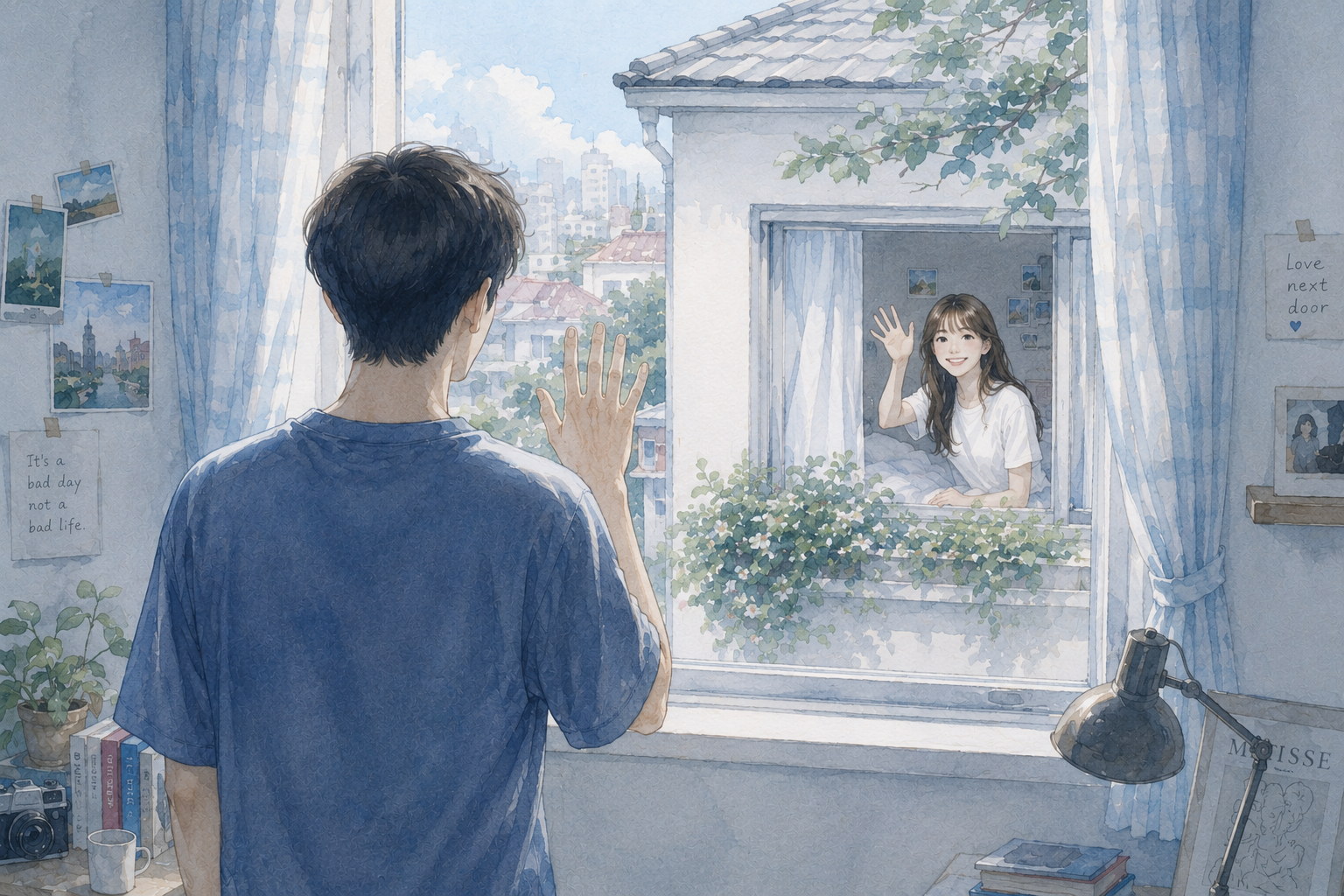
Love Next Door (2024) is one of those dramas that kept popping up in my YouTube Shorts feed and making me laugh every single time. The clips looked undeniably funny, but I never really felt compelled to hunt it down on OTT.
Then I watched Something in the Rain (2018).
Jung Hae-in’s performance completely swept me off my feet. Naturally, that sent me down the rabbit hole of looking up his filmography and adding everything remotely interesting to my watchlist. That’s how Love Next Door eventually found its way there.
What I expected was a cozy childhood-friends-to-lovers romance. You know the type; lots of bickering, a few misunderstandings, and eventually a confession under some strategically placed streetlights.
What I didn’t expect was a story about burnout, parental expectations, career pressure, illness, friendship, grief, and the strange feeling of returning home only to realize that you’re no longer the same person who left.
At first glance, Love Next Door feels warm and familiar. It has the comfort of a neighborhood drama, the charm of childhood friendships, and enough comedy to keep things moving. But underneath all that, it quietly explores what happens when life doesn’t go according to plan.
And honestly, that hit harder than I expected.
Cast and Their Other Work
Jung Hae-in as Choi Seung-hyo
Jung Hae-in plays Choi Seung-hyo, an accomplished architect who appears to have everything figured out. Calm, dependable, and endlessly patient, Seung-hyo is the kind of male lead who doesn’t need grand gestures to be charming.
I’ve seen Jung Hae-in in quite a few dramas over the years: the charming and playful younger boyfriend in Something in the Rain (2018), the mature and emotionally guarded single father in One Spring Night (2019), the rookie soldier pursuing deserters while questioning the system in D.P. (2021–2023), and the North Korean agent torn between loyalty and humanity in Snowdrop (2021–2022).
Here, he plays a successful architect trying to balance a growing business while quietly carrying feelings he’s never managed to put into words.
There is a quiet realism to Jung Hae-in’s acting that I find difficult to describe. He never feels like he’s performing for the audience. Instead, he gently takes you along on the character’s journey and leaves a lasting impression long after the credits roll.
Jung So-min as Bae Seok-ryu
Jung So-min plays Bae Seok-ryu, the neighborhood golden child who seemingly had everything; a successful career abroad, impressive achievements, and a bright future.
Until she didn’t.
Seok-ryu returns home after abruptly walking away from the life she built overseas, carrying secrets that gradually unfold throughout the series.
This was actually my first time watching Jung So-min in a leading role, and needless to say, I’d love to explore more of her work in the future.
You may recognize her from Because This Is My First Life (2017), The Smile Has Left Your Eyes (2018), or Alchemy of Souls (2022).
Kim Ji-eun as Jung Mo-eum
Kim Ji-eun plays paramedic Jung Mo-eum, Seok-ryu’s best friend and arguably one of the most lovable characters in the entire drama.
Her friendship with Seok-ryu feels genuine and lived-in, making many of their scenes together a joy to watch.
Her other works include Again My Life (2022) and Branding in Seongsu (2024).
Yoon Ji-on as Kang Dan-ho
Yoon Ji-on portrays journalist Kang Dan-ho, whose storyline gradually becomes one of the sweetest surprises of the series.
He previously appeared in dramas such as Tomorrow (2022) and You Are My Spring (2021).
Detailed Plot (Spoilers Ahead!)
The story begins with Bae Seok-ryu returning to Korea after walking away from what appeared to be a perfect life.
She had a prestigious job, an impressive career path, and a fiancé. From the outside, she looked like the embodiment of success. But appearances can be deceiving.
Behind all those achievements was a woman exhausted from constantly meeting expectations. Years of pressure had slowly consumed her until she finally reached a breaking point.
Her return home isn’t the triumphant comeback everyone expects. Instead, it’s awkward, uncomfortable, and filled with questions she desperately wants to avoid answering.
Naturally, returning home places her back into the orbit of Choi Seung-hyo.
Seung-hyo and Seok-ryu grew up together. Their mothers are close friends, their families know everything about each other, and they share decades of history.
This history creates some of the drama’s funniest moments.
The two know exactly which buttons to push. They argue constantly, tease each other relentlessly, and somehow still end up helping each other through every crisis.
Unlike many childhood-friends-to-lovers stories, their chemistry feels grounded because their connection isn’t built overnight. It’s supported by years of affection, frustration, misunderstandings, and familiarity.
As the story progresses, we learn that Seok-ryu’s return wasn’t solely about burnout.
One of the drama’s most emotional revelations is her battle with illness. This storyline completely shifts the tone of the series. What initially appears to be a simple career crisis becomes something much deeper.
Her fear, uncertainty, and struggle to regain control over her life become central to the narrative. Rather than turning the illness into a melodramatic plot device, the drama uses it to explore vulnerability and self-worth.
For perhaps the first time in her life, Seok-ryu has to stop proving herself to everyone else and start figuring out what she actually wants.
Meanwhile, Seung-hyo has quietly loved Seok-ryu for years.
And I mean years.
One of the recurring themes of the show is timing. Sometimes the right person appears at the wrong time. Sometimes feelings remain unspoken for so long that they become part of everyday life.
Watching Seung-hyo navigate these emotions is both sweet and slightly painful. The drama takes its time with their romance, allowing friendship to remain at the center of their relationship. When they finally begin moving toward each other romantically, it feels earned rather than rushed.
The supporting cast also contributes significantly to the drama’s emotional weight.
Mo-eum and Dan-ho’s relationship provides an engaging secondary romance that develops naturally and offers a refreshing contrast to the main couple.
Meanwhile, the parents are far more than background characters.
The drama spends considerable time examining family expectations, generational differences, and the sacrifices parents make. Some of the most emotional scenes in the entire series aren’t romantic at all; they involve conversations between parents and children.
By the finale, Love Next Door becomes less about romance and more about healing.
Seok-ryu learns to move forward without measuring her worth through achievements. Seung-hyo finally allows himself to pursue the future he truly wants. The supporting characters find their own paths as well.
It’s a hopeful ending, but not a fairy tale one.
The characters don’t magically solve every problem. Instead, they simply become more honest with themselves.
And somehow that feels more satisfying.
Audience Reception
Audience reactions to Love Next Door were largely positive, though some criticisms emerged.
Viewers especially praised the chemistry between Jung Hae-in and Jung So-min, as well as the drama’s relatable exploration of burnout, career pressure, and the complicated relationship many people have with success.
Some felt that the middle episodes dragged slightly or that certain side storylines deserved more development. Even so, the drama maintained a loyal audience throughout its run.
The general consensus seemed to be that while Love Next Door didn’t reinvent the genre, it executed familiar tropes with sincerity and heart.
My Fangirl Commentary
After watching Love Next Door (2024), I can officially declare this to be one of the best executions of the friends-to-lovers trope that I’ve seen in a long time.
Jung Hae-in and Jung So-min’s on-screen chemistry is phenomenal.
I absolutely loved the earlier episodes where Seok-ryu and Seung-hyo express their affection through what can only be described as “controlled violence”. Seung-hyo relentlessly roasts Seok-ryu, while Seok-ryu keeps trapping him in headlocks to remind him who’s actually in charge.
Their banter is written so naturally that it never feels forced. Watching them reminded me of my college days, when my friends and I spent half our conversations pulling each other’s legs. There is something incredibly nostalgic about friendships where teasing becomes its own love language.
Seok-ryu’s character also felt refreshingly real.
She doesn’t act cute on purpose. She isn’t quirky because the script tells her to be. She’s observant, thoughtful, stubborn, and deeply caring.
I especially loved her monologues. The realization that she had loved Seung-hyo for years while never knowing who his first love was felt surprisingly heartbreaking.
Seok-ryu has always been there for Seung-hyo.
She was his loudest supporter when he was swimming competitively, and when he slipped into a depressive phase after being forced to give up the sport, she refused to leave his side. She unapologetically broke through his walls and stopped him from being consumed by the darkness.
Her struggles with workplace politics were another aspect of the drama that felt personally relatable.
Because yes, people who constantly try to be useful to everyone often end up being exploited by the world. Opportunistic people step on their backs and move ahead while they continue carrying the extra burden.
Seung-hyo, meanwhile, is basically the definition of a green flag.
Some male leads are unnecessarily rude to their love interests because the writers mistake emotional immaturity for romance. Seung-hyo is not one of them.
He teases Seok-ryu because they’re friends, not because he’s trying to humiliate her.
His love language is definitely acts of service. Whether it’s redecorating her room with childhood memories, quietly supporting her dreams, or helping her rediscover her passion, Seung-hyo constantly shows up for the people he loves.
He’s the kind of soulmate most people hope to find at least once in their lifetime.
I also have several favorite scenes from this drama.
The swimming pool scene where Seung-hyo helps Seok-ryu stay afloat while casually asking “hypothetical” questions to figure out her relationship status remains one of my favorites.
Every single headlock scene made me laugh.
And when the parents eventually discover their relationship? Absolute gold.
I adored the friendship between the mothers of Seok-ryu, Seung-hyo, and Mo-eum throughout the series. Equally heartwarming was watching Seok-ryu’s father and Seung-hyo’s father slowly become confidants despite not initially being close.
If I had one criticism, it’s that I enjoyed the dynamic between Seok-ryu and Seung-hyo more during the first half of the series.
Once the romance officially begins, they remain friends first and lovers second, which I appreciated. However, I couldn’t help missing some of the playful chaos from the earlier episodes.
To be fair, many dramas suffer from this issue. As the plot becomes more serious, the characters gradually lose some of the lighthearted charm that made viewers fall in love with them in the first place.
That said, the romance still works because it feels real.
This isn’t a fairy tale love story that appears overnight.
It’s the culmination of countless small moments accumulated over years. It’s built on showing up for each other through difficult seasons, sharing victories and failures, and quietly becoming part of each other’s lives.
There is no dramatic declaration beneath a shower of flower petals.
Just two people choosing each other, again and again.
And somehow that feels far more romantic.
One final observation: Jung Hae-in looked noticeably different in this drama compared to some of his previous works. I initially couldn’t figure out what seemed different, but after looking online, it turns out many viewers had the same thought.
Personally, I don’t care whether an actor has had cosmetic procedures or not. People are free to do whatever helps them feel comfortable in their own skin. It was simply something I noticed while watching the show.
Final Verdict
Love Next Door is not the most groundbreaking K-drama you’ll ever watch. It doesn’t rely on shocking twists, high-stakes suspense, or dramatic cliffhangers. Instead, it succeeds because it understands something simple: growing up doesn’t stop when you’re thirty.
Sometimes adulthood means starting over. Sometimes it means returning home. Sometimes it means realizing that the life everyone envies isn’t necessarily the life you want. And sometimes it means discovering that the person who has been standing beside you all along might actually be the one who understands you best.
With strong performances from Jung Hae-in and Jung So-min, heartfelt emotional moments, a charming neighborhood atmosphere, and a romance built on years of friendship, Love Next Door delivers exactly what many viewers look for in a comfort drama.
It made me laugh, made me emotional, and occasionally made me want to shake certain characters by the shoulders. Which, honestly, is usually a good sign.
Rating: 8.5/10
Warm, comforting, occasionally messy, and full of heart, Love Next Door feels like spending an evening with old friends you haven’t seen in a while and realizing you missed them more than you thought.
My Recommended Picks For You

Fight for My Way (2017): Chasing Dream and Love #440
“Fight for My Way” (2017) is that messy, warm-hearted comfort drama that reminds you it’s okay to be a little lost in your twenties; as long as you’ve got your people (and maybe your long-time best friend who suddenly looks a little too good in that T-shirt). It’s equal parts laughter, heartbreak, and chasing impossible dreams; with just the right dose of chaos and chemistry to keep your heart fluttering.

One Spring Night (2019): When Love Arrives Quietly… and Refuses to Leave
One Spring Night (2019) begins with something small… almost forgettable; but somewhere between hesitation, guilt, and longing, it grows into a love you can’t ignore… even when you probably should.
Share this:

Discover more from Joy of Untangling
Subscribe to get the latest posts sent to your email.


